Insurance Loss - Water & Flood
Water and Flood Damage Restoration
Extraction, a measured drying curve, mold remediation and sewage backup handling, then the rebuild once the structure is genuinely dry.
Chapter 01
What the water actually did while nobody was looking
Standing water is the visible part of a flood or a burst line. The part that decides the job is what happened after it soaked in: into a stud bay, under a slab-on-grade floor, behind a baseboard. Extraction pulls the water you can see. Drying is what deals with the water you can't, and it's measured, not eyeballed. We track moisture readings against the framing and subfloor, not just the surface of a wall, because a painted surface can read dry days before the material underneath actually is.
Gulf coast humidity works against that clock. In a lot of the country, an open window and a fan will finish the job. Here, ambient moisture is already high most of the year, so drying leans on commercial air movers and dehumidifiers running a real cycle, with logged readings, until the numbers say the structure is done, not until it looks done.
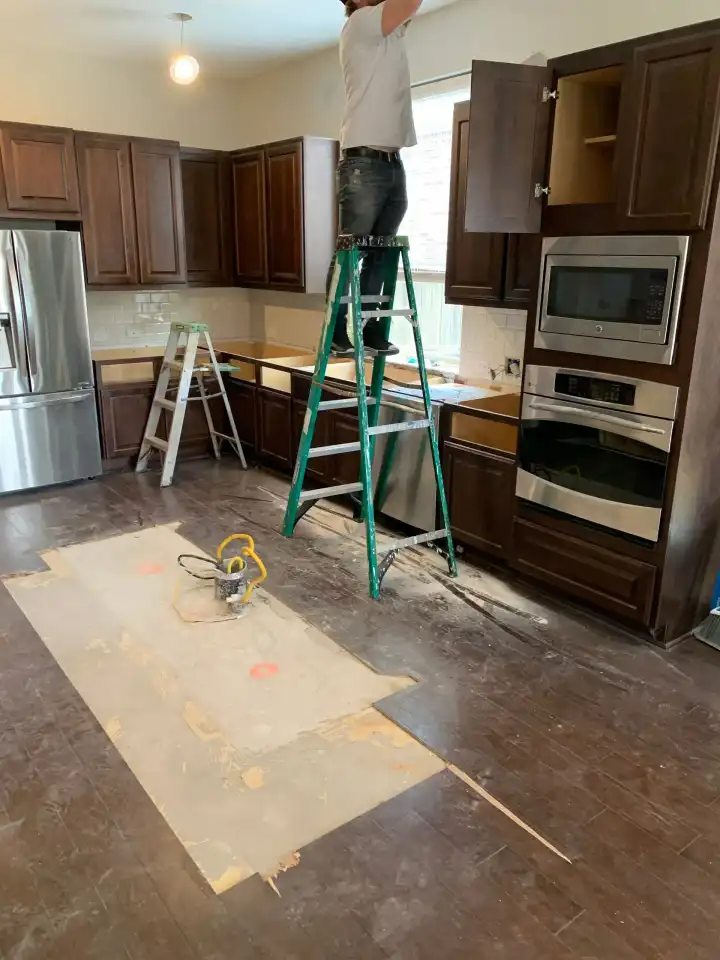
A Cypress kitchen mid-remodel, floor protection down, upper cabinets open and a crew member working at the ceiling line, face out of frame.
Why the second claim shows up six weeks later
Mold doesn't need a flood to start. It needs organic material and moisture that sits for longer than a couple of days, and drywall paper, wood framing and insulation are exactly that. The version of this job that goes wrong is the one where drying gets called finished early and a wall gets closed back up over material that's still holding moisture. Weeks later, that shows up as a smell, a stain bleeding through fresh paint, or a second insurance claim nobody wanted to file.
Where mold has already established, remediation is its own step before reconstruction, not a footnote inside it: contained removal of affected material, HEPA filtration and negative air pressure so spores don't spread to unaffected rooms while the work is happening, and cleaning of everything that's staying.
Chapter 03
When it's category three: sewage backup
Not every water loss is clean water. A sewage backup or a flood that's picked up ground contamination gets classified as category three, and that classification changes what happens to the materials it touched. Porous material that's been in contact with category three water, carpet pad, drywall, some insulation, generally can't be sanitized back to safe. It gets removed and replaced rather than dried and reused, and that decision gets made up front rather than discovered later.
This is also the water category where doing it yourself carries real risk, not just inconvenience. We handle the containment and disposal correctly the first time, and we document the category and the scope for your insurance company, because a category three claim is scrutinized differently than a clean-water loss.
Rebuilding only once the structure is actually dry
The rebuild phase looks like an ordinary remodel from the outside: drywall, insulation, flooring, trim, paint. What's different is the starting condition. We're building back into a space that was recently open studs and bare subfloor, which means matching what was there, coordinating whatever trades the loss touched (electrical, plumbing, sometimes cabinetry), and closing it up in a sequence that doesn't trap any residual moisture behind the new finish.
Same-day service is available for urgent needs including flood damage, and we work directly with your insurance company on your behalf through the whole thing, extraction through the last coat of paint, so you're not the one translating between the adjuster, the drying crew and the trades doing the rebuild.
Pinnacle Construction responds same-day for urgent flood damage and works directly with your insurance company on your behalf. Call (281) 214-9251.
How it actually sequences
Mitigation, then reconstruction. Two phases, never rushed into one.
Extraction
Standing water comes out first, with pumps and extractors sized to the amount actually on the floor. Nothing else starts until the water itself is gone.
Drying and monitoring
Air movers and dehumidifiers go in, and moisture readings get logged daily against the framing and subfloor, not just the surface. A wall can look dry and still be wet two inches in.
Remediation, if it's needed
Where mold has already started, affected material comes out under containment with negative air pressure, so spores do not travel to the rest of the house while the work happens.
Reconstruction
Drywall, insulation, flooring and finishes go back in once the moisture readings actually confirm dry, not on a calendar guess.
Every one of Pinnacle Construction's 40 project photos on this site is remodeling or commercial build-out work. See real matched frames from finished jobs across Cypress and the Houston Metro.