Insurance loss
Insurance Loss Reconstruction
Fire, storm, wind and water losses across the Houston Metro, worked start to finish with your insurance company on your side of the table.
Chapter 01
The first 48 hours: what to document before anything gets moved
The instinct after a loss is to start cleaning up right away, and that instinct works against you. Before anything gets pulled out, thrown away or dried off, it needs to be photographed and listed: the water line on the drywall, the char pattern on a stud, the section of roof deck the wind took, the contents in the room as they actually sat. An adjuster who shows up to a space that has already been cleaned is working from your memory instead of the evidence, and that gap tends to show up later as a lower payout.
That doesn't mean nothing happens for two days. Mitigation, tarping a roof, extracting standing water, boarding an opening, starts immediately to stop the damage from getting worse. It just means the record gets made first, alongside the emergency work, not skipped in the rush to fix things.
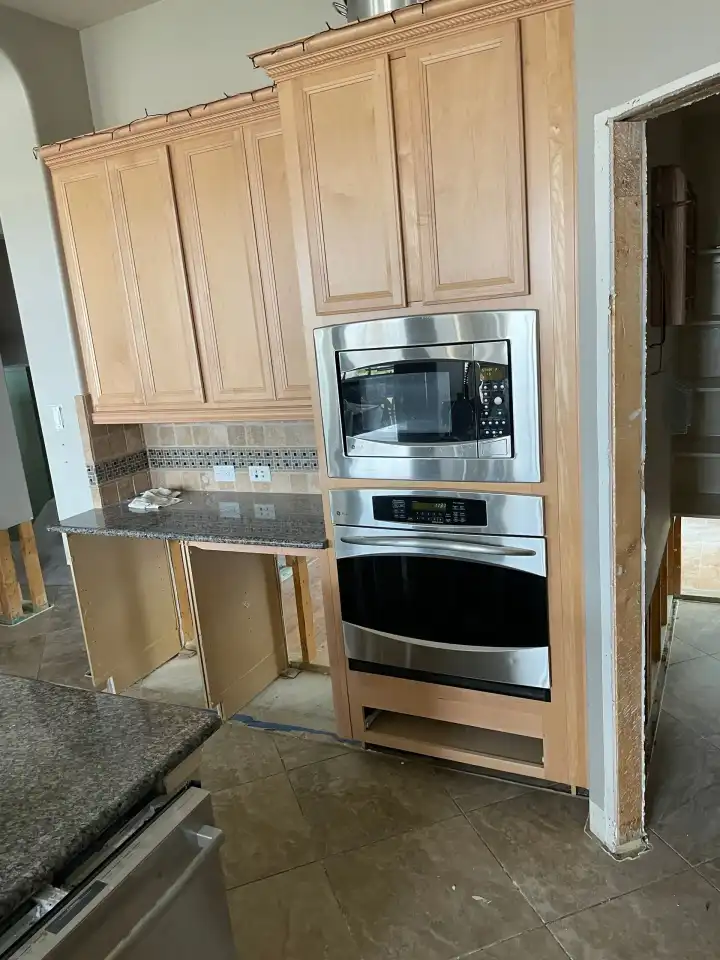
Kitchen demolition mid-project: base cabinets stripped back to the studs and a doorway opened to bare framing.
Working the claim with the carrier, not against it, on your behalf
Once the loss is documented, the scope has to match what actually happened, and that's where a lot of homeowners and business owners get shorted. An initial adjuster estimate is a starting point, not a final number. If the scope misses hidden water damage behind a wall, or prices a repair instead of the replacement the code actually requires, that has to be supplemented and re-argued with the carrier, in the carrier's own language.
We work directly with the insurance company on your behalf for exactly this reason. You're not the one translating between an adjuster's line-item estimate and what a framer, an electrician and a drywall crew actually need to do the job right. We handle the scope conversation, the supplements, and the adjuster walk, so your role stays being the person deciding what the finished space should look like.
Chapter 03
Mitigation first, reconstruction second, and why the two are not the same job
Mitigation is stopping the damage: extracting water, drying out a structure, boarding up an opening, tarping a roof. Reconstruction is putting the building back. They're sequenced, not simultaneous, because you can't frame, insulate and finish a wall that's still wet or a roof that's still open to weather, and most carriers underwrite them as separate phases of the same claim.
Keeping them distinct matters for the work and for the paperwork. A wall that gets closed up before it's actually dry hides mold and rot that shows up again in a year, and a claim that blends mitigation costs with reconstruction costs is harder for an adjuster to approve cleanly. We run the mitigation phase to completion, confirm the structure is actually dry, and only then move into the rebuild.
Getting the family or the business back in
The end point of a loss claim isn't a repaired wall, it's a family back in their kitchen or a business back open on its regular hours. That's the frame we plan the rebuild around: what sequence gets the space usable soonest without cutting corners on the parts that don't get re-inspected once the drywall closes it up.
For a home, that can mean prioritizing a working kitchen and bathroom before finish details elsewhere in the house. For a business, it can mean phasing the rebuild so part of the space reopens while another section is still under construction. Same-day service is available for urgent needs, including flood damage, because the faster mitigation starts, the shorter the whole claim runs.
Pinnacle Construction works directly with insurance companies on the client's behalf, and handles all required permits. Call (281) 214-9251.
One claim, four kinds of loss
The four ways we rebuild after a loss
Fire damage reconstruction
Structural rebuild, smoke and soot removal, odor elimination and the water damage firefighting itself causes.
Read more →Water and flood damage restoration
Extraction, a measured drying curve, mold remediation and sewage backup handling, then the rebuild once the structure is dry.
Read more →Storm and wind damage repairs
Emergency board-up and dry-in first, then roof, siding, windows and doors treated as one envelope.
Read more →Interior and exterior rebuilds
Facade to finish carpentry, structural repair and energy-efficient upgrades folded into the same rebuild.
Read more →